July 15, 2024. Documenta Institute / Museum Fredericianum, Kassel (DE).
Public lecture delivered within the series “Global Modernities?” Full series program here.
art historian, curator, editor
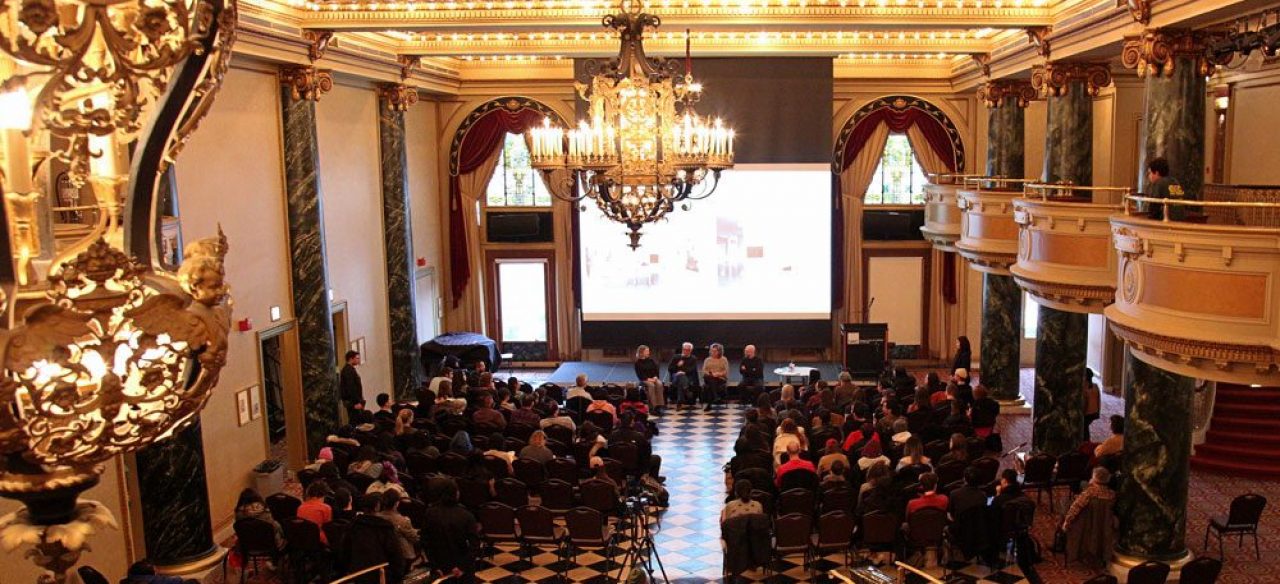

July 15, 2024. Documenta Institute / Museum Fredericianum, Kassel (DE).
Public lecture delivered within the series “Global Modernities?” Full series program here.

February 15, 112th College Art Association (CAA) Annual Conference, Chicago. Panel chair.
Countering the tendency to present women artists as overlooked figures in (art) history, this CAA panel considered women’s lives and work as symptomatic for artistic subjectivities formed under Communism.
October 7, 2023. Cleveland Museum of Art.
Panel discussion with the artists representing the U.S. at the 2023 Architecture Biennale in Venice, in the exhibition titled Everlasting Plastics: Xavi Aguirre, Simon Anton, Li, Norman Teague and Lauren Yeager. The panel was a part of a larger, two-day symposium organized by Case Western Reserve University’s Department of Art History and Art and the Cleveland Museum of Art. See the event webpage here.


April 12, 2023. School of the Art Institute of Chicago.
A third and final panel discussion in the series of dialogues on anti-racism featuring art and design leaders from various backgrounds, this event interrogated how the international art world both perpetuates and can work against racialized inequities.

March 26, 2023. Red Line Service, a Chicago arts organization led by people with a lived experience of homelessness. redlineservice.org
Talk delivered as a part of the Red Line Service’s Art Histories Series.
Nov 9-12, 2022. 54th ASEEES (The Association for Slavic, East European, & Eurasian Studies) Annual Convention, Chicago.
A roundtable discussion about Agata Pietrasik’s “Art in a Disrupted World” (Warsaw Museum of Modern Art 2021), an important and unprecedented book offering a new look at artistic life in Poland in the ten years following the outbreak of World War II.

March 3-5, 2022. 110th College Art Association Annual Conference, Chicago. Panel co-chaired with Dr. Agata Pietrasik, Freie Universitaet, Berlin.
Traveling art exhibitions gained momentum in the mid-20th century as an efficient mode of engaging global audience. The importance of traveling shows was confirmed by the 1953 UNESCO’s Manual of Traveling Exhibitions, a document that solidified traveling exhibitions as a new means of mass communication. Importantly, traveling exhibitions traversed not only geographical borders. They crossed boundaries between aesthetics and politics, engaging different discourses and ideological frameworks, ranging from issues of national self-representations to art’s role in diffusing socialism.

November 18, 2021. Online. Project website.
“Socialist Exhibition Cultures” examines global art exhibitions organized, between 1950 and 1990, in or by (formerly) socialist or Communist countries. These include the Soviet Union and other Communist/socialist states in Eastern Europe; China; North Korea; South Korea; Cuba, and Africa, including Mozambique, Ethiopia, and Angola. We consider Cold War socialist exhibitions instances of a curatorial culture that developed as an alternative to the Western art market and its international outlets, and according to its own set of demands and prerogatives.
Read More “Socialist Exhibition Cultures—International Workshop”

Nov 16, 2021. Bruges Triennial 2021: TraumA
Talk delivered as a part of the series “On the Afterlife of Monuments” organized by the Bruges Triennial of Contemporary Art and Architecture. The event was inspired by the project “Who is Afraid of Natasha?” by Joanna Malinowska and C.T. Jasper presented at the triennial. (Event on the organizer’s website here.)
 Magdalena Moskalewicz